From the outside in

Tuesday, November 29, 2011

Police hand- and ankle-cuff 5yo, charge him with battery on a police ... #FAIL

via Boing Boing by Mark Frauenfelder on 11/29/11

Police feel safer in Stockton, California, after they successfully subdued a big, scary 5-year-old boy, cuffing him with cable straps and charging him with "battery on a police officer."

In it, the officer, Lt. Frank Gordo, says he placed his hand on Michael's and, "the boy pushed my hand away in a batting motion, pushed papers off the table, and kicked me in the right knee."

When Michael wouldn't calm down, Gordo cuffed Michael's hands and feet with zip ties and took the boy to the Stockton Kaiser Psychiatric Hospital in the back of a squad car.

He had not called Michael's mother or father at that point.

Michael was cited for battery on a police officer.

"I didn't know until two or three weeks later that my son was zip tied," Gray said.

Her ex-husband had picked Michael up from the hospital. When he arrived, Michael's wrists were still zip tied behind his back.

5-Year-Old Handcuffed, Charged With Battery On Officer (Via The Agitator)

Posted via email from The New Word Order

Senate set to pass bill that redefines America as a "battlefield," authorize...

via Boing Boing by Cory Doctorow on 11/29/11

The US Senate's Defense Authorization Bill redefines America as a "battlefield" and authorizes US troops to conduct military arrests of civilians on US soil, and to indefinitely detain citizens without charge or trial. The ACLU wants you to write to your senator and demand that this insanity not pass.

The Senate is going to vote on whether Congress will give this president—and every future president — the power to order the military to pick up and imprison without charge or trial civilians anywhere in the world. Even Rep. Ron Paul (R-Texas) raised his concerns about the NDAA detention provisions during last night’s Republican debate. The power is so broad that even U.S. citizens could be swept up by the military and the military could be used far from any battlefield, even within the United States itself.

The worldwide indefinite detention without charge or trial provision is in S. 1867, the National Defense Authorization Act bill, which will be on the Senate floor on Monday. The bill was drafted in secret by Sens. Carl Levin (D-Mich.) and John McCain (R-Ariz.) and passed in a closed-door committee meeting, without even a single hearing.

I know it sounds incredible. New powers to use the military worldwide, even within the United States? Hasn’t anyone told the Senate that Osama bin Laden is dead, that the president is pulling all of the combat troops out of Iraq and trying to figure out how to get combat troops out of Afghanistan too? And American citizens and people picked up on American or Canadian or British streets being sent to military prisons indefinitely without even being charged with a crime. Really? Does anyone think this is a good idea? And why now?

Senators Demand the Military Lock Up American Citizens in a “Battlefield” They Define as Being Right Outside Your Window (via JWZ)

Posted via email from The New Word Order

Neil DeGrasse Tyson interviewed by out-of-character Stephen Colbert

via Boing Boing by Cory Doctorow on 11/29/11

The Kimberley Academy in Montclair, New Jersey hosted a fascinating, one-hour chat between Neil DeGrasse Tyson -- Hayden Planetarium director, TV science host, and all-round good guy -- with Stephen Colbert in a rare, out-of-character appearance.

Stephen Colbert Interview - Montclair Kimberley Academy (via Kottke)

Posted via email from The New Word Order

Voynich Manuscript online

via Boing Boing by Cory Doctorow on 11/28/11


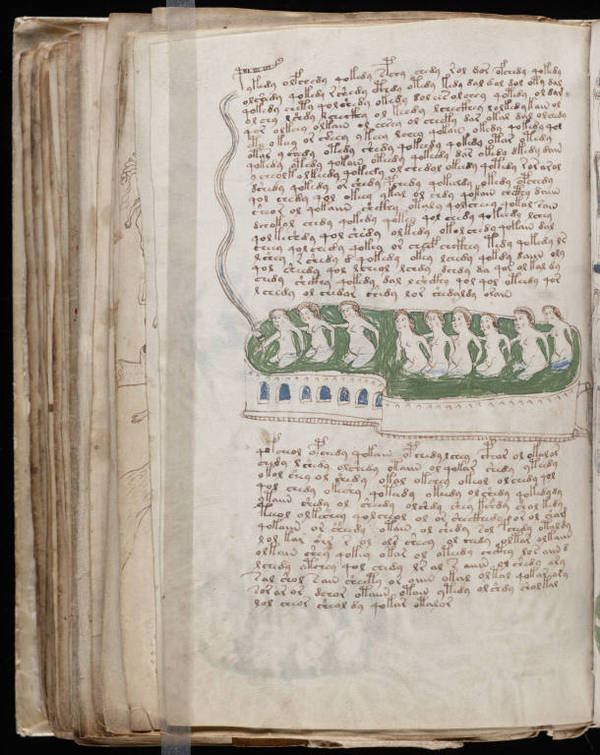
Avi sez, "Yale's Beinecke Rare Book and Manuscript Library has put complete high resolution scans of the enigmatic, undeciphered Voynich Manuscript online."

Written in Central Europe at the end of the 15th or during the 16th century, the origin, language, and date of the Voynich Manuscript—named after the Polish-American antiquarian bookseller, Wilfrid M. Voynich, who acquired it in 1912—are still being debated as vigorously as its puzzling drawings and undeciphered text. Described as a magical or scientific text, nearly every page contains botanical, figurative, and scientific drawings of a provincial but lively character, drawn in ink with vibrant washes in various shades of green, brown, yellow, blue, and red.

Based on the subject matter of the drawings, the contents of the manuscript falls into six sections: 1) botanicals containing drawings of 113 unidentified plant species; 2) astronomical and astrological drawings including astral charts with radiating circles, suns and moons, Zodiac symbols such as fish (Pisces), a bull (Taurus), and an archer (Sagittarius), nude females emerging from pipes or chimneys, and courtly figures; 3) a biological section containing a myriad of drawings of miniature female nudes, most with swelled abdomens, immersed or wading in fluids and oddly interacting with interconnecting tubes and capsules; 4) an elaborate array of nine cosmological medallions, many drawn across several folded folios and depicting possible geographical forms; 5) pharmaceutical drawings of over 100 different species of medicinal herbs and roots portrayed with jars or vessels in red, blue, or green, and 6) continuous pages of text, possibly recipes, with star-like flowers marking each entry in the margins.

VOYNICH MANUSCRIPT (Thanks, Avi!)

Posted via email from The New Word Order

Monday, November 28, 2011

Secret records of US bank bailout released, over howls of protest $7.7 Trillion

via Boing Boing by Cory Doctorow on 11/28/11

Bloomberg has won a lengthy Freedom of Inforn battle to get the details of a secretive, no-strings-attached multi-trillion-dollar payout from the Bush administration (continued by the Obama administration) to banks, the details of which were not available to Congress. The documents make it clear that the banks' posture that they were only borrowing the money to help the government (JP Morgan said it borrowed "at the request of the Federal Reserve to help motivate others to use the system") were purest refined BS. Morgan for example, had borrowed twice its cash holdings.

The Fed, headed by Chairman Ben S. Bernanke, argued that revealing borrower details would create a stigma -- investors and counterparties would shun firms that used the central bank as lender of last resort -- and that needy institutions would be reluctant to borrow in the next crisis. Clearing House Association fought Bloomberg’s lawsuit up to the U.S. Supreme Court, which declined to hear the banks’ appeal in March 2011.

The amount of money the central bank parceled out was surprising even to Gary H. Stern, president of the Federal Reserve Bank of Minneapolis from 1985 to 2009, who says he “wasn’t aware of the magnitude.” It dwarfed the Treasury Department’s better-known $700 billion Troubled Asset Relief Program, or TARP. Add up guarantees and lending limits, and the Fed had committed $7.77 trillion as of March 2009 to rescuing the financial system, more than half the value of everything produced in the U.S. that year.

“TARP at least had some strings attached,” says Brad Miller, a North Carolina Democrat on the House Financial Services Committee, referring to the program’s executive-pay ceiling. “With the Fed programs, there was nothing...”

Lawmakers knew none of this.

They had no clue that one bank, New York-based Morgan Stanley (MS), took $107 billion in Fed loans in September 2008, enough to pay off one-tenth of the country’s delinquent mortgages. The firm’s peak borrowing occurred the same day Congress rejected the proposed TARP bill, triggering the biggest point drop ever in the Dow Jones Industrial Average. (INDU) The bill later passed, and Morgan Stanley got $10 billion of TARP funds, though Paulson said only “healthy institutions” were eligible.

Secret Fed Loans Gave Banks Undisclosed $13B (via The Awl)

Posted via email from The New Word Order

Explosive Bloomberg Report Details Fed’s Monster Bank Bailouts: $7.77 Trillion

via Firedoglake by Scarecrow on 11/28/11

The Federal Reserve Headquarters in Washington, DC (photo: Dan Smith)

In a monster report for its January issue, Bloomberg Magazine compiled previously secret Federal Reserve Bank data on the size and scope of the bank bailouts and lending during 2008-2009.

Among other things, we learn that the Federal Reserve under Ben Bernanke and Tim Geithner (previously head of the New York Fed) secretly loaned over seven trillions dollars to arguably insolvent banks and financial institutions to keep them afloat, while concealing the scope of the lending from Congress and even member of the Treasury Department charged with allocating TARP bailouts.

Much of this information on the Fed’s lending programs was already known in summary form as a result of the successful “audit the fed” legislation pushed by a coalition that included Firedoglake.  That effort led Bloomberg to further successful Freedom of Information Act requests that retrieved another 29,000 pages of more detailed documents.

The Bloomberg report compiles and analyzes this information to reveal the staggering effort undertaken by the Federal Reserve in 2008-2009, both to keep the financial system, including the nation’s largest banks, from collapsing and to keep the details secret from Congress as it was considering the TARP legislation in 2008 and the financial reform legislation and regulations in 2009-11.

Among the most dramatic findings:

  • – While the the Fed and Treasury frequently boast that virtually all the TARP money was paid back, the major banks also received a “gift” of an estimated $13 billion in profits resulting from the difference between near zero interest rate loans and market rates.
  • – The publicly debated TARP funding request was for $700 billion to be administered by the Treasury, but the Federal Reserve Bank had committed 11 times that much — $7.77 trillion — to its secret guarantees and lending facilities by March 2009. (Eventual totals may have been twice that amount.)
  • – The heads of the major banks routinely misled investors, without corrections from federal officials, about their utter dependence on the Fed’s loan facilities. For example,

“On Nov. 26, 2008, then-Bank of America (BAC) Corp. Chief Executive Officer Kenneth D. Lewis wrote to shareholders that he headed “one of the strongest and most stable major banks in the world.” He didn’t say that his Charlotte, North Carolina-based firm owed the central bank $86 billion that day. . . .”

  • – There were virtually no strings attached to the institutions that received the loans.

[cont'd]

  • – The Fed essentially decided which banks would receive TARP funds from Treasury, but the amounts were dwarfed by Fed loans.  “The six biggest U.S. Banks, which received $160 billion of TARP funds, borrowed as much as $460 billion from the Fed . . .”
  • – The big six — JP Morgan, Bank of America, Citigroup, Wells Fargo, Goldman Sachs and Morgan Stanley — “accounted for 63 percent of the average daily debt to the Fed” for all publicly traded financial firms, far more than their total market share.
  • – Ben Bernanke and Hank Paulson insisted the loans were made only to “sound institutions,” even though the largest firms were essentially supported by Fed loans and TARP.
  • – Congress members working on the financial reform law claim to have been kept in the dark about the extent of the Fed lending programs and the degree of reliance by the largest financial institutions.  The concealment played a major role at a time when Senators Kaufman and Brown were fighting unsuccessfully to break up the TBTF banks.  The Administration opposed any breakup, arguing that larger sizes were essential for efficiency and international competition, the same position taken by bank lobbyists.
  • – While there was much publicity about Bush Treasury Secretary Hank Paulson “forcing” the largest banks to accept TARP funds, all of them were already relying heavily on low-interest Fed loans, which were not disclosed to Congress:

“Bank of America and New York-based Citigroup each received $45 billion from TARP. At the time, both were tapping the Fed. Citigroup hit its peak borrowing of $99.5 billion in January 2009, while Bank of America topped out in February 2009 at $91.4 billion. . . .

“Lawmakers knew none of this.

“They had no clue that one bank, New York-based Morgan Stanley (MS), took $107 billion in Fed loans in September 2008, enough to pay off one-tenth of the country’s delinquent mortgages.”

  • – Democratic Senators Kaufman, Brown and Dorgan argue that Congress would have been much tougher on the banks in the financial reform legislation if the extent of the lending had been revealed.  Instead, the largest banks grew even larger, increased compensation to executives, and increased spending on Congressional lobbying to limit the scope of financial reforms and subsequent regulation.

“Total assets held by the six biggest U.S. banks increased 39 percent to $9.5 trillion on Sept. 30, 2011, from $6.8 trillion on the same day in 2006, according to Fed data.”

The entire Bloomberg report is worth reading.  It does not argue that the lending programs were unnecessary or too large; it includes quotes from those who believe they were necessary.  Instead, the thrust of the story is that information about the massive size and scope of these efforts was deliberately concealed from Congress and the American people during a critical period.

That concealment shielded the financial industry from more drastic reform efforts and accountability, leaving the industry even larger and too big to regulate.  I’d add that the concealment also shielded federal regulators on how massive a rescue effort they believed was required to make up for their regulatory failure.

More from Yves Smith, Quelle Surprise! Everyone lied.

David Dayen’s take:

The banks were able to access emergency lending facilities, or change themselves into bank holding companies overnight, to borrow at next to nothing, and if they chose, lend back to the government at a tidy profit. You didn’t have to think at all to make money. And you didn’t have to worry about that toxic balance sheet, because the government was going to help you grow your way out of it. They will also facilitate mergers to help decimate your competition. The money that the banks borrowed for nothing could have just as easily gone to underwater homeowners.

Share This icon 

Posted via email from The New Word Order

Nov. 28, 1660: Hey, Guys, Let's Found Britain's Foremost Scientific Academy

via Wired Top Stories by Tony Long on 11/28/11

With intellectual curiosity -- especially a love of science -- as their common bond, an informal group of uncommon men establish what will become the Royal Society.

Posted via email from The New Word Order